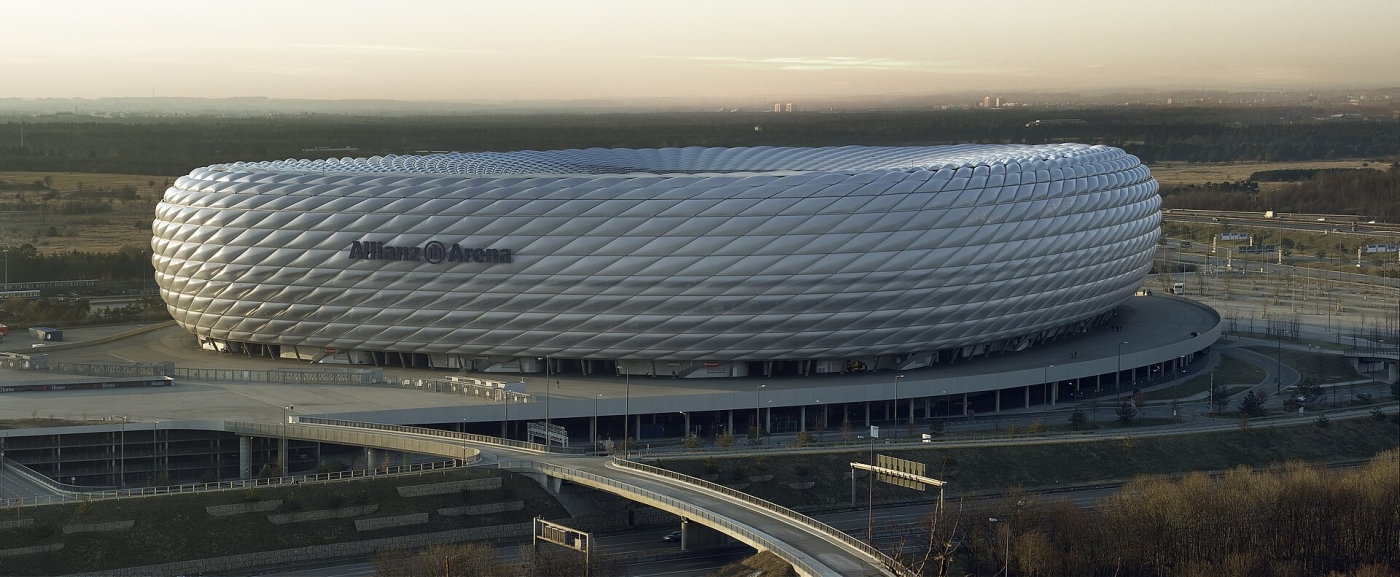
Allianz Arena
Werner-Heisenberg-Allee 25, München, Germany
About the Stadium:
The Allianz Arena, nestled in the northern district of Fröttmaning in Munich, Germany, stands as a shimmering testament to modern football architecture and a vibrant symbol of Bavarian passion. Since its inauguration, it has captivated fans worldwide, establishing itself as one of Europe’s most recognisable and technologically advanced stadiums.
A Vision Born in the New Millennium
The concept for the Allianz Arena emerged in the late 1990s and early 2000s, driven by the need for a state-of-the-art stadium to replace the aging Olympiastadion, particularly for the upcoming 2006 FIFA World Cup. Construction began in October 2002, culminating in its grand opening on May 30, 2005. The stadium was initially a joint venture between FC Bayern Munich and their city rivals, TSV 1860 Munich, designed by the renowned Swiss architectural firm Herzog & de Meuron. It quickly earned the affectionate nickname "Schlauchboot" (inflatable boat) due to its unique, cushion-like exterior.
Iconic Design and Unrivalled Atmosphere
What truly sets the Allianz Arena apart is its groundbreaking facade, composed of 2,760 inflated ETFE plastic panels. These panels can be individually illuminated in various colours, famously glowing red for FC Bayern Munich matches, blue for TSV 1860 Munich (during their tenancy), and white for Germany national team games. This dynamic lighting system turns the stadium into a colossal, living beacon visible for miles. Inside, the bowl design ensures an exceptional atmosphere, with a capacity of approximately 75,000 for Bundesliga matches and 70,000 for international fixtures, drawing fans closer to the action and amplifying the roar of the crowd.
Home to Bavarian Giants and Global Events
Originally shared, FC Bayern Munich acquired TSV 1860 Munich's 50% stake in 2006, making them the sole owners, with TSV 1860 Munich continuing as tenants until 2017. Today, the Allianz Arena is the exclusive home of FC Bayern Munich, one of the most successful clubs in European football history. Beyond club heroics, the stadium has been a prestigious host for major international tournaments. It staged several matches during the 2006 FIFA World Cup, including the opening game. In 2012, it hosted the UEFA Champions League Final, where FC Bayern Munich famously lost to Chelsea FC in their own stadium. More recently, it was one of the venues for UEFA Euro 2020, held in 2021, and is set to host matches again for UEFA Euro 2024. Its enduring appeal lies in its blend of architectural brilliance, technological innovation, and its central role in both local and international football history.